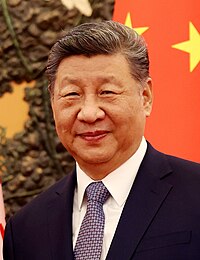
Xi Jinping
# INTELLIGENCE DOSSIER: XI JINPING
## Prepared for Senior Analysts | Classification: Strategic Monitoring
Xi Jinping is the paramount leader of the People's Republic of China and serves as General Secretary of the Communist Party, President, and Chairman of the Central Military Commission—consolidating civilian, party, and military authority in a single individual whose decisions cascade across 1.4 billion citizens and shape global geopolitical alignments. His strategic significance derives from command over the world's second-largest economy, a nuclear arsenal of 400+ warheads, and the military capability to project power across the Indo-Pacific, making him arguably the second most consequential decision-maker in international relations after the U.S. President.
Xi's position on the LeadersCartel Power Index reflects sustained influence at rank 31 with a 4.4 intensity score, monitored across 732 discrete intelligence sources showing 6 high-impact signals, 1 emerging signal, and 0 watch-tier signals—indicating stable, concentrated power with minimal volatility. This mid-tier ranking captures the paradox of Xi's position: dominant within China's closed system yet constrained by alliance structures and economic interdependence in the global order. The signal distribution suggests his influence operates primarily through established channels rather than emergent crises, reflecting consolidated domestic control.
This week's developments reveal mounting pressure on Xi's regional strategy. Trump's public warnings regarding Chinese arms supplies to Iran directly challenge Beijing's Middle East positioning and signal escalating U.S.-China strategic competition. Simultaneously, reporting on loyalty purges within Xi's inner circle—the "Cina: Ujian Loyalitas" coverage—suggests internal consolidation activities, while the reference to purged generals indicates ongoing military structure reorganization. These three signals collectively indicate Xi is simultaneously managing external pushback on Iran policy while conducting internal security maintenance.
Analysts should monitor the next 48-72 hours for any official Chinese response to Trump's arms-supply allegations, particularly statements regarding Iran or U.S. relations that would signal either escalation or de-escalation posturing. The critical trigger event to watch is whether additional U.S. sanctions target Chinese entities involved in Iran transfers, which would force Xi toward either confrontation or strategic retreat—either outcome carrying significant implications for allied nations including India and Pakistan.