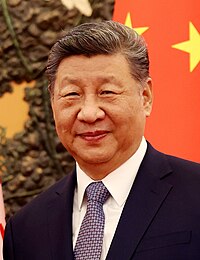
Xi Jinping
Xi Jinping is the current President of the People's Republic of China and General Secretary of the Communist Party of China, making him the paramount leader of the world's second-largest economy and a nuclear-armed superpower with 1.4 billion citizens. His global significance derives from China's position as a manufacturing hub, technology competitor, and geopolitical counterweight to U.S. dominance. Xi matters strategically because his decisions on Taiwan, South China Sea claims, AI development, and Belt and Road initiatives directly shape regional stability and global supply chains affecting every major economy. His control over China's military, surveillance apparatus, and state enterprises positions him as one of the few leaders capable of executing coordinated grand strategy across economic, military, and technological domains simultaneously.
Xi currently ranks 17th on the LeadersCartel Power Index with a score of 19.4, tracked across 68 distinct intelligence sources. His tier classification as "monitored" reflects stable but not dominant positioning relative to active peer competitors, with signal distribution showing zero high-impact alerts, two emerging signals, and zero watch-level escalations. This ranking suggests Xi's power remains substantial but faces constraints—likely reflecting competitive pressure from the Trump administration's renewed strategic posture and domestic economic headwinds. The seven-day signal decay rate indicates consistent rather than accelerating activity, suggesting consolidation rather than expansion of influence during this reporting window.
Three critical developments emerged this week. First, analysis titled "A Tired U.S.-China Tango" signals diplomatic fatigue in bilateral engagement under Trump's second administration. Second, reporting on "US and China race to shape AI agenda ahead of Xi-Trump talks in Shenzhen" indicates Xi is preparing direct negotiation with Trump on artificial intelligence governance—a domain where China competes directly with American technological supremacy. Third, coverage of "Russia's Lavrov, China's Wang discuss cooperation, Ukraine, Iran at Asia security" confirms Xi's coordinated alignment with Putin on geopolitical opposition to Western interests. Each signal reflects active positioning rather than reactive posture.
Over the next 48-72 hours, analysts should monitor whether confirmed Xi-Trump talks in Shenzhen occur as scheduled and what outcomes emerge on AI regulation frameworks. Watch for any statements from Chinese state media signaling either compromise or hardline positions. The specific trigger event to monitor is whether China agrees